Is Agentic AI Architecture Different for On-Premises and Edge?

Engineers moving agentic AI systems from cloud pilots into on-premises, edge, or air-gapped environments often discover that the agent fails long before the reasoning loop breaks. LangGraph users have reported conversation state disappearing after restarts despite configured checkpointers, while other teams have encountered hidden outbound dependencies that prevent startup in default-deny environments. These are documented production failures which occur below the agent layer.
The industry has largely solved observability. LangChain’s State of Agent Engineering survey found that 94% of production teams have some form of observability implemented, while 57% already have agents in production. The remaining challenge is infrastructure design.
This distinction matters because agentic AI architecture has two layers. The first is the cognitive architecture: perception, reasoning, planning, tool use, and evaluation. That layer remains portable across cloud, on-premises, edge, and air-gapped deployments. The second is the substrate: memory and state persistence, retrieval infrastructure, the model envelope, and failure handling under disconnection. That layer changes with every environment.
This article shows exactly what stays the same, what must be redesigned, and how to scope the work before you provision hardware.
Agentic AI Architecture Components
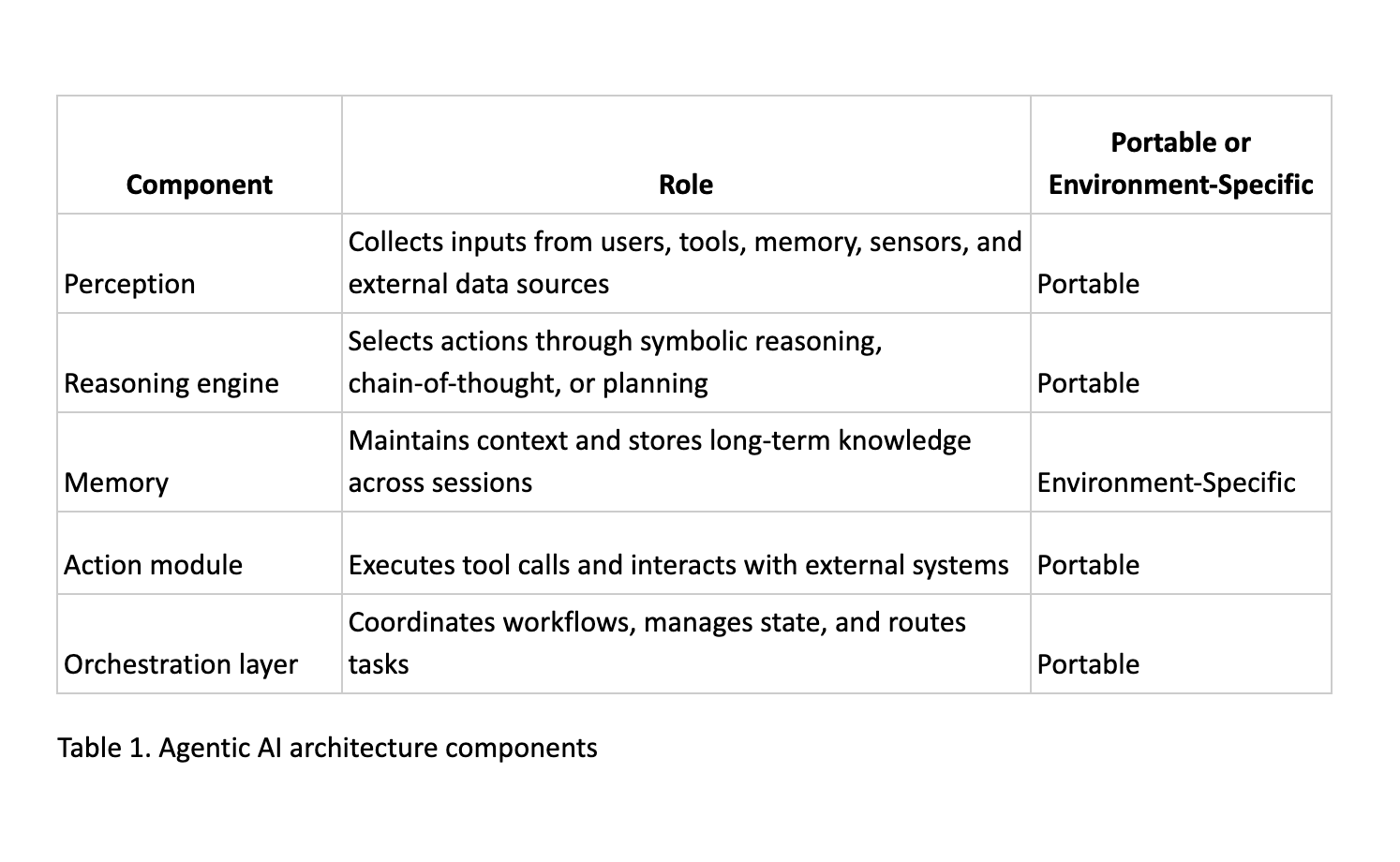
The core components of an agentic AI architecture remain the same regardless of whether your agent runs in the cloud, on-premises, or on edge hardware. Every agentic AI system follows the same sequence: perceive information, reason about it, access memory, take action, and repeat the loop until it reaches a goal.
Perception is the entry point. The agent processes inputs from user requests, external data sources, sensor feeds, tool outputs, company data, structured data, web search results, and memory retrievals. This information becomes the working context for decision-making.
The reasoning engine is the cognitive core of the agent. Modern AI agents typically use one or more reasoning approaches:
Symbolic reasoning applies predefined rules and logic. It is predictable but less flexible when conditions change.
Chain-of-thought reasoning breaks complex tasks into intermediate steps, allowing the model to work through a problem sequentially.
Planning selects and orders actions required to achieve a defined goal, often across multiple tool calls and multi-step tasks.
Memory allows the agent to maintain context over time. Short-term memory stores information needed during the current task or conversation. Long-term memory stores historical interactions, user preferences, previous outcomes, and the agent’s knowledge across sessions. This is the first component where deployment environment matters. Long-term memory depends on persistent memory infrastructure, vector stores, and storage systems that differ significantly between cloud, on-premises, and edge deployments.
The action module executes work. It performs tool calls, queries databases, invokes external systems, accesses knowledge graphs, writes code, updates business systems, and interacts with external tools on behalf of the user.
The orchestration layer coordinates the entire workflow. It manages state, routes tasks between specialized agents, tracks task progress, and enables multi-agent collaboration when multiple agents work together. Most agentic systems operate as an iterative loop: perceive, reason, act, observe the result, and re-plan until the objective is complete.
At this level, every agent architecture looks similar. The differences begin when you decide how memory, retrieval, models, and infrastructure operate underneath these components.
The agentic AI architecture is the backbone of many industrial use cases, such as in autonomous vehicles, healthcare, and industrial automation.
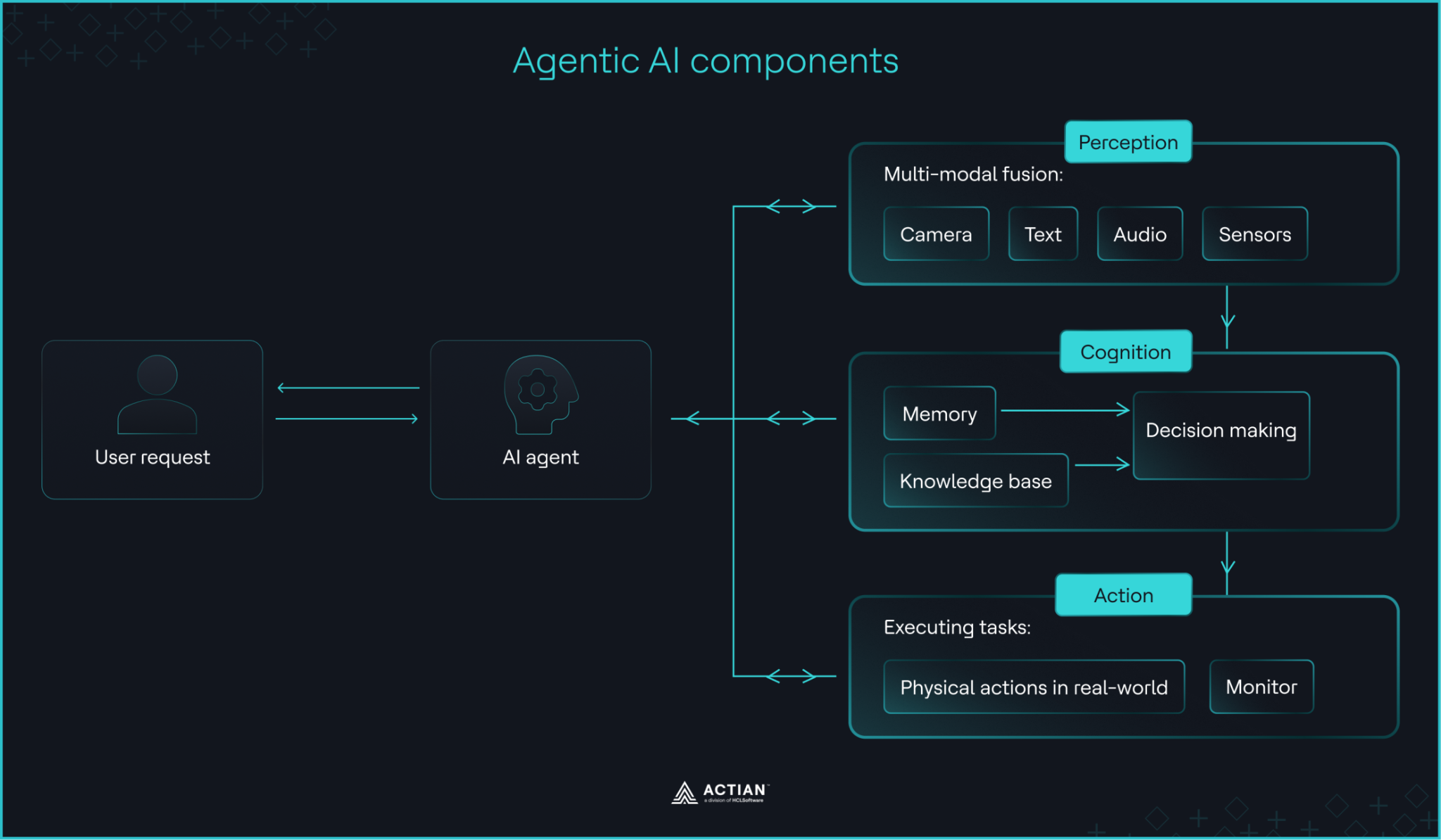
Figure 1: Agentic AI components
Agentic AI Architecture Patterns
The orchestration pattern determines how your AI agents collaborate to complete work. Whether you deploy in the cloud, on-premises, or at the edge, the same agentic AI architecture patterns apply. The environment does not change the pattern. It changes the infrastructure underneath it.
A single-agent architecture uses one agent to handle a task from start to finish. Use this pattern when a single user request requires limited coordination and one agent can access all required tools, data sources, and business logic.
Multi-agent systems divide work across multiple specialized agents. Each agent develops specific agent skills and focuses on a defined responsibility, reducing task complexity and improving scalability.
The most common multi-agent patterns include:
Sequential pattern: Each agent depends on the output of the previous agent. Use this when tasks must follow a strict workflow, such as research, validation, and report generation.

Figure 2: Sequential pattern
Parallel pattern: Multiple agents execute independent subtasks simultaneously. Use this when work can be split into separate streams such as market research, document analysis, and data collection.
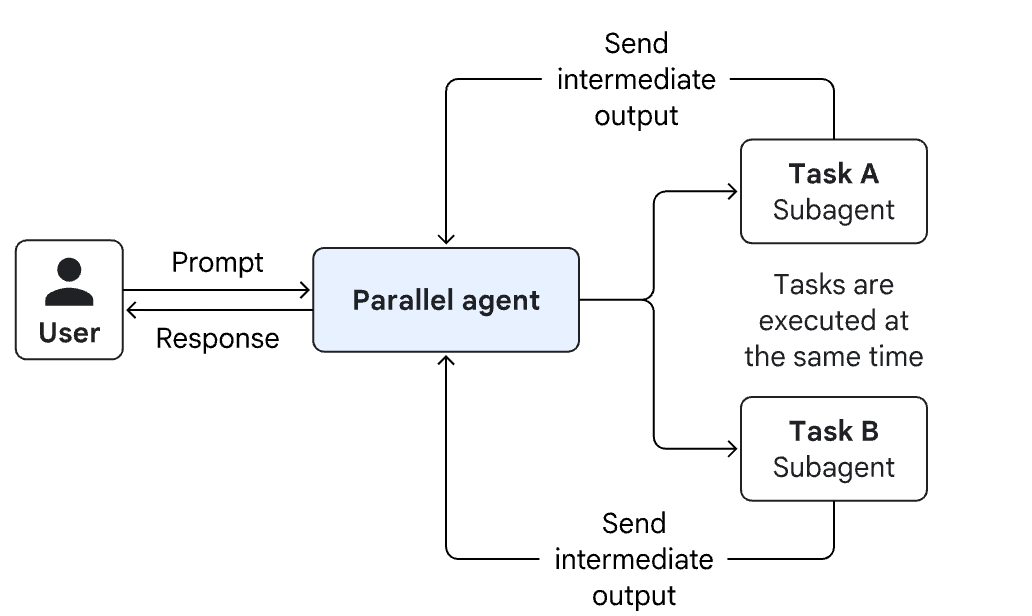
Figure 3: Parallel pattern
Hierarchical pattern: A supervisor agent delegates tasks to specialist agents and reviews their outputs. Use this when complex problems require centralized coordination and quality control.
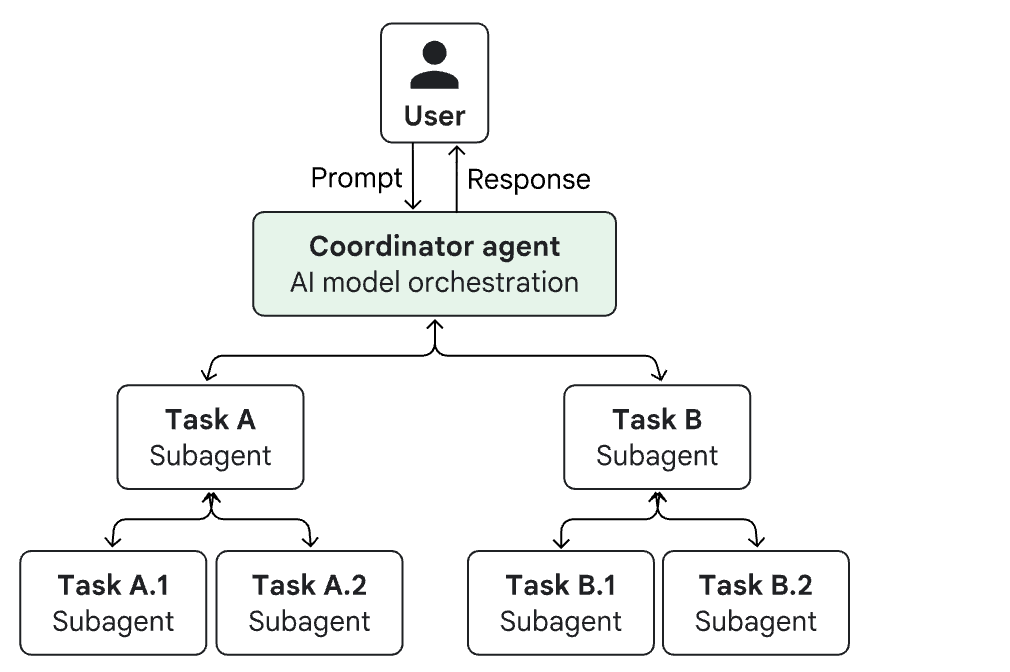
Figure 4: Hierarchical pattern
Router pattern: A dispatcher evaluates each request and routes it to the most appropriate specialized agent. Use this when different requests require different expertise, tools, or AI models.
These patterns form the foundation of modern agentic systems. The communication protocols, orchestration layer, task automation logic, and agent-to-agent interactions remain consistent across deployment models. Model Context Protocol (MCP) defines how agents connect to external tools and data systems, while Agent-to-Agent (A2A) governs communication between agents.
The important point is that none of these patterns change when you move from a cloud deployment to an on-premises or edge deployment. A hierarchical multi-agent architecture remains hierarchical. A router-based system remains router-based. The redesign work begins in the underlying infrastructure that supports memory, retrieval, model execution, and resilience.
What Stays the Same Across Every Environment
The cognitive layer of your agent does not change when the deployment environment changes. Whether deployed in a public cloud, private data center, factory environment, or fully air-gapped network, the same core reasoning frameworks, orchestration mechanisms, and evaluation methodologies remain applicable.
The agent loop remains identical. Most modern agentic AI systems implement either the ReAct (Reasoning and Acting) pattern or a Plan-and-Execute pattern. In both approaches, the agent receives information, reasons about the next action, executes that action, evaluates the result, and repeats the loop until it completes the task. The loop does not change because the server location changes.
Tool-use interfaces are also portable. Standards such as Model Context Protocol (MCP) and Agent-to-Agent (A2A) define how agents interact with external tools, services, and other agents. The calling convention remains the same whether the target system is a cloud-hosted application programming interface (API), an on-premises database, or a local service running on the same device.
Evaluation practices remain unchanged as well. You still measure performance using trace-based debugging, task completion rates, and tool failure metrics. Air-gapped deployments may require a local model instead of a cloud-based evaluator, but the evaluation pipeline remains identical.
This distinction is important because many teams assume they must redesign their entire agent architecture when moving to a constrained environment. In practice, the cognitive architecture transfers directly. The redesign work occurs in the infrastructure supporting that architecture.
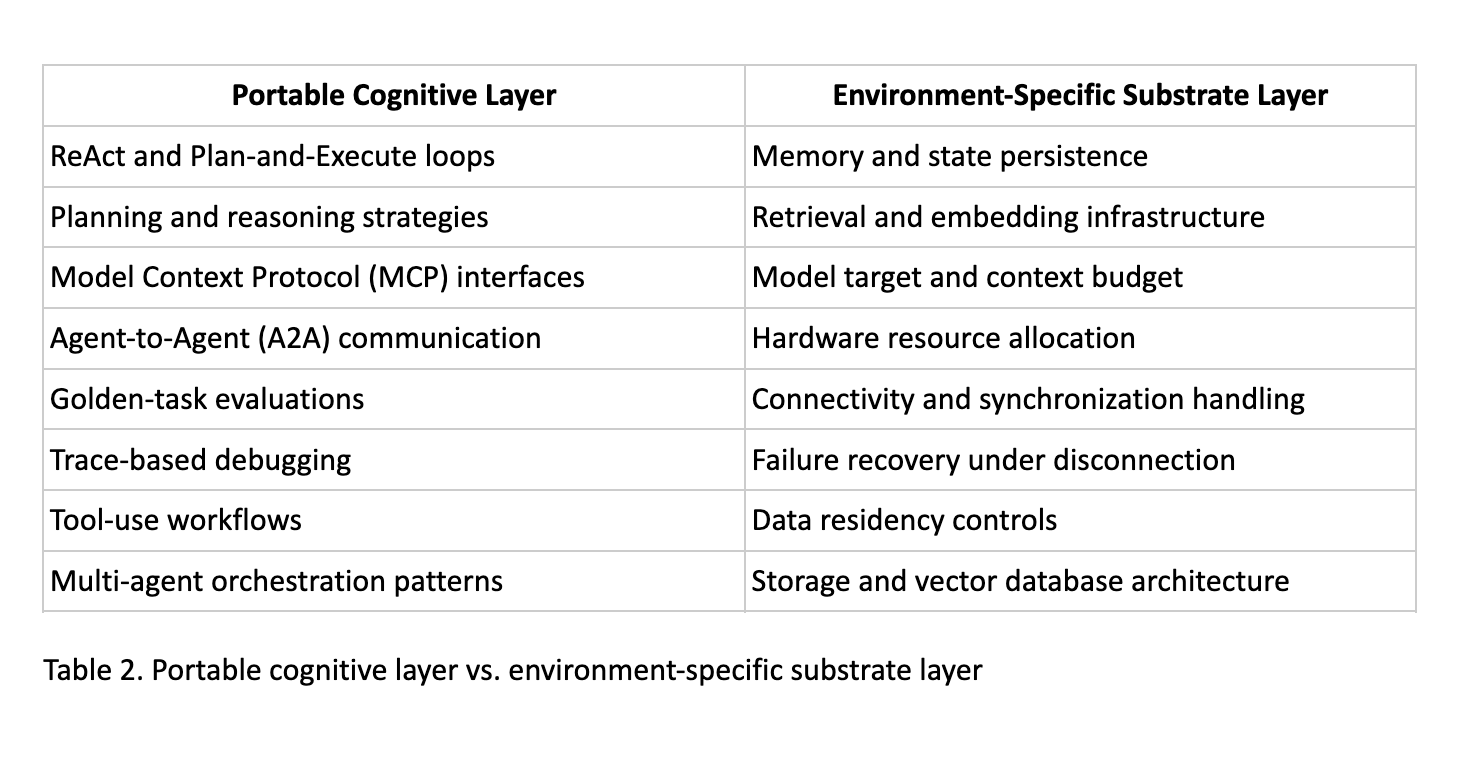
Before changing architectures, separate these two layers. Keep the cognitive layer intact. Redesign the substrate layer for the environment you are deploying into.
Memory and State Persistence
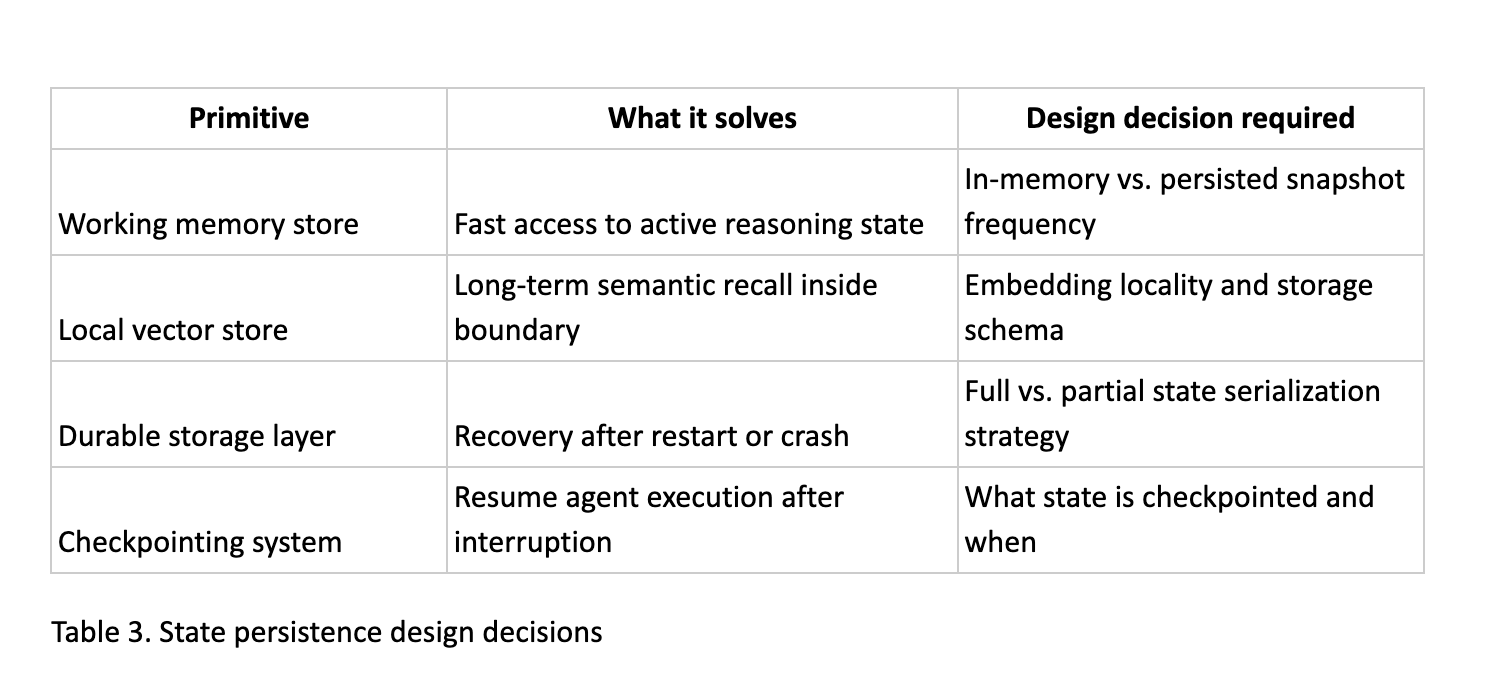
State persistence is the first point where agentic AI architecture breaks when you move out of the cloud. The system forgets everything the moment the process restarts unless you explicitly redesign how memory is stored, serialized, and recovered per environment.
In cloud deployments, memory is typically offloaded to managed services. A hosted vector database and external memory service handle long-term state, while the agent only maintains ephemeral context during execution. This works because connectivity is assumed and checkpointing systems are managed externally.
In on-premises and edge deployments, relying on external storage services is often not practical. Instead, agent memory should be organized as a three-tier local storage architecture.
In-memory working store: Holds active state and context needed during reasoning, providing sub-millisecond access for real-time operations
Local vector store: Maintains long-term semantic memory within the deployment environment, enabling efficient retrieval without sending data outside the system
Durable storage layer: Stores audit logs, checkpoints, and recovery data, allowing full state reconstruction after restarts or failures
All three layers should operate within the same trust boundary to eliminate hidden dependencies on external infrastructure.
Edge deployments introduce additional constraints. On devices with limited resources (for example, 8GB of RAM), continuously serializing the entire agent state may be too expensive.
VectorAI DB fills the local vector store tier. It runs inside the deployment boundary and serves semantic retrieval without an external service.
Retrieval Infrastructure
Retrieval infrastructure determines whether your agent respects data boundaries and whether it can operate within latency budgets outside the cloud. In cloud deployments, retrieval typically spans a managed vector database and an external embedding service. The agent sends a query, the embedding model runs in a remote environment, and the vector store returns ranked results over the network. This design assumes unrestricted egress and stable connectivity. In on-premises and edge deployments, that assumption breaks. A compliant in-boundary vector store does not guarantee residency if embeddings are still generated through a foundation model API outside the deployment boundary. Both the embedding pipeline and the vector store must reside in the same environment. For air-gapped systems, this requires a self-hosted embedding model running locally on the same node or within the same cluster as the vector store.
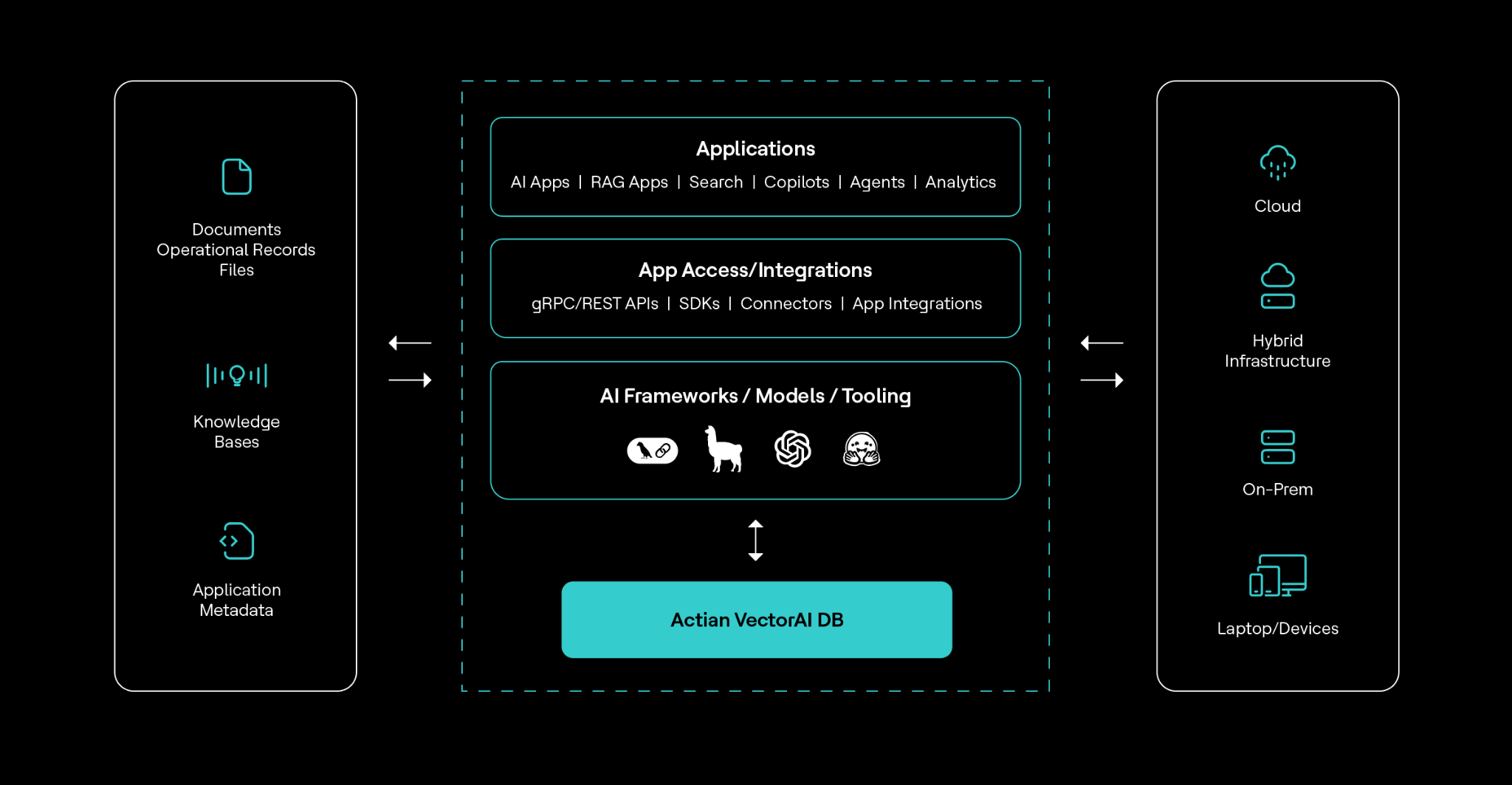
Figure 5: Actian VectorAI DB architecture
Latency also changes the design space. Cloud retrieval introduces network round-trips that dominate the agent loop in multi-step workflows. On-premises retrieval removes that overhead and reduces latency to sub-millisecond ranges when the vector store is colocated with the agent runtime. This latency budget is not saved; it is reinvested into additional reasoning cycles, tool calls, or verification steps within the agent loop.
On edge hardware, retrieval becomes even more constrained. Generation competes with embedding and search workloads for limited CPU and memory resources, forcing strict limits on retrieval depth and embedding frequency.
The Model Envelope
The model envelope defines the hard limits of what your agent can compute, how fast it responds, and how much reasoning it can safely delegate to the model itself. The agent architecture remains stable across environments, but the model layer becomes a constraint problem as soon as you move off cloud infrastructure.
In cloud deployments, you can scale model size, context window, and throughput dynamically. In edge and on-premises systems, the envelope is fixed by hardware. On 8GB-class edge devices such as the Jetson Orin Nano, quantized 4B to 8B parameter models typically run at around 14 tokens per second under constrained configurations. As context windows grow, the model hits hardware and attention scaling limits that degrade performance unless strict maximum context length constraints are enforced.
This creates a design constraint that does not exist in cloud deployments. You must explicitly define max-model-len and enforce eager execution modes to prevent unstable memory behavior. Without these constraints, long-running agent loops degrade unpredictably under sustained context growth.
Smaller models introduce higher variance in multi-step reasoning. In cloud systems, the model can compensate through scale, retries, or ensemble approaches. In constrained environments, the agent must compensate instead. This shifts part of the reasoning burden from the model to the system design itself. Decision logic that would normally be handled through reasoning must be explicitly encoded in orchestration rules, tool routing policies, or deterministic fallback paths.
Failure Handling Under Disconnection
Failure handling changes fundamentally when your agent cannot assume continuous connectivity. In cloud systems, disconnections are treated as exceptions. In on-premises, edge, and air-gapped environments, disconnection is the default operating condition.
The first required primitive is a connectivity state machine. Your system must explicitly define transitions between online, degraded, transitioning, and offline states. These transitions must be debounced to prevent rapid oscillation, which otherwise leads to repeated retries, duplicated tool calls, and inconsistent agent behavior. Without this structure, agents thrash under unstable network conditions instead of recovering.
The second primitive is priority sync queues. When connectivity is restored, the system must not attempt to synchronize all state at once. You must define strict ordering for what gets synced first: critical state updates, execution logs, tool results, and finally non-essential metadata. This ordering decision determines whether the system recovers consistently or reintroduces partial state corruption after reconnection.
The third primitive is idempotent operation logs. Every action executed while offline or in a degraded state must be safely replayable. This requires every tool call, database write, and external interaction to include deterministic identifiers so that re-execution does not create duplicates. Without idempotency, replayed actions can produce duplicate side effects or inconsistent state unless the system adds deduplication or replay protection.
These primitives do not exist in typical cloud agent designs because connectivity is assumed. In constrained environments, they become core architectural requirements. Without them, every temporary network interruption becomes a state corruption event.
Wrapping Up
Agentic AI architecture does not change when you move from cloud to on-premises, edge, or air-gapped environments. The cognitive layer stays stable. Your agent still perceives inputs, reasons through a task, plans actions, executes tools, and iterates through the same loop until completion.
Memory and state persistence determine whether an agent can recover after a restart. Retrieval infrastructure affects data access, boundaries, and latency. The model envelope defines how much reasoning can be delegated to the model versus hard-coded into the system. Failure handling during disconnections determines whether the system recovers gracefully or breaks under network instability.
In cloud environments, memory and state persistence are often abstracted away by managed services. In constrained environments, they become explicit design work that must be resolved before deployment.
Get started with Actian VectorAI DB Community Edition today. Check the documentation for deployment and usage instructions, and participate in the Discord community for support and discussions.